

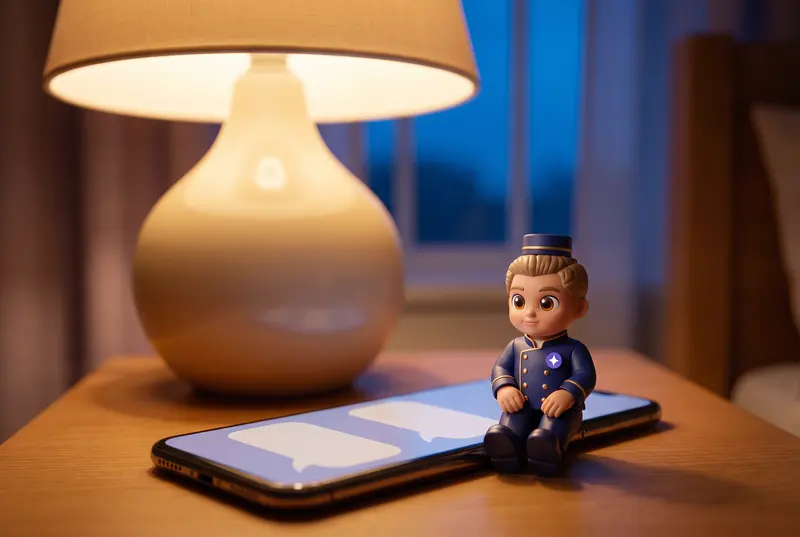
WhatsApp for hotels can mean two different things: a line for you, where the work reaches you on your phone, or a channel for your guests, where someone has to answer them. They share an app and ask very different things of a hotel with twenty rooms. The first takes little more than a phone. The second brings rules on permission, a price per message if you move to the paid platform, and a guest who expects someone to be there.
Tuesday, 21:13. Anna's phone buzzes.
Anna is laying the breakfast room for tomorrow when Sam, the chat on the Hotel Kadeloft site, sends her a question he may not answer himself. A family wants six rooms for two nights in May. A group price commits the hotel, so it comes to her.
She reads it, types two lines and goes back to the spoons. No login, no dashboard. The family never sees her WhatsApp: they asked on the website, and her answer reaches them by email.
Hotel Kadeloft, Anna and this family are made up. Six rooms at €110 for two nights is €1,320.
That is one way a hotel can use WhatsApp. The other way looks the same on a sales page and is a different job, so ask which of the two you are being sold.
Two jobs in one app
WhatsApp for the owner
- Who writes: your helpers or your staff, to you
- When: in the hours you agree. Ours go quiet from 22:00 to 09:00
- If you miss it: the question waits until you look
- What it needs: the phone you already carry
- Whose rules: mostly your own
WhatsApp for the guest
- Who writes: a guest, to the hotel, at any hour
- When: whenever they like, so someone has to be there or say when they will be
- If you miss it: the guest sees silence and may go elsewhere
- What it needs: a business number, a person on duty, and answers to the questions that repeat
- Whose rules: Meta's, plus privacy law
Why the owner's side is small
A good part of an owner's evening is short decisions: yes, no, €1,320. Those fit in a message, and nobody else at the hotel can make them. A dashboard waits for you to open it. A message comes to you, which is its use and its cost, so the hours matter.
This is what reaches Anna from us today, and how:
| Helper | What comes to her | How |
|---|---|---|
| Sam | Group prices, complaints, commitments and unconfirmed allergy questions from the website chat | WhatsApp, 09:00 to 22:00. Her answer goes to the guest by email |
| Marco | Replies to Google reviews, the first three always as drafts | |
| Wes | A preview of the change she asked for on her site | By message. Live only after she says publish |
| Gigi | Her next update for the Google profile | By email first |
What comes in after ten waits until nine the next morning. In our view a tool that can wake you at three about a charging point is no help, even if Kadeloft has two on the quay.
If your own staff share a group chat, the same thinking applies. Use it for what someone has to decide, and keep passports and card numbers out of it.
What Meta's rules say about guests
We read the WhatsApp Business Messaging Policy, last updated on 23 September 2026. It covers both the free app and the paid platform. These are the rules that matter most at a hotel:
- Permission first. You may contact someone only if they gave you their number and agreed to hear from you. How you get that agreement, and whether it meets local law, is your responsibility.
- A number on a booking is not that agreement, as we read it. Booking.com's terms, clause 2.8.3, also forbid unsolicited messages to the guest details it gives you.
- Stop means stop. You must respect a request to stop, whether it comes on WhatsApp or elsewhere.
- No card or ID numbers. You may not share or ask for full card numbers, account numbers, ID card numbers or other sensitive identifiers. So a message asking for a passport number before arrival does not belong here.
- A way to reach you. Your business profile needs support contact details, kept up to date.
The free app or the paid platform
| Business app | Business Platform | |
|---|---|---|
| Cost | Free to download | Per delivered message, by country and type |
| Starting a chat | Permission rule applies | Only with an approved template |
| Replying | The 24-hour window is in the platform rules only | Free text within 24 hours of the guest's last message, templates after that |
| Automation | Greeting and away messages, quick replies | Allowed in that window, with a clear route to a person |
| Set up by | You | A solution provider or your own developer |
One thing does not add up. Meta's developer documentation says service messages, the replies inside those 24 hours, are charged again from 1 October 2026, after 1,000 free ones a month per number. Its pricing page still says it does not charge for them. If the first is right: at an assumed two nights a stay, Kadeloft has about 182 stays a month, so 1,000 messages is about five per stay. Ask your supplier which applies.
A bot may answer. Meta's pricing page names conversational AI bots for service messages, and its platform terms restrict companies whose main offering is AI, with exceptions in certain countries, which is something else than a hotel with a bot. In the EU, Article 50 of the AI Act says people must be told they are talking to an AI unless that is obvious.
The real price is the evening
The rules are the easy part. Kadeloft has two people at the desk on busy days and fewer on the others, and at 21:13 it is Anna. In our view a public WhatsApp number on the website is a second front desk that needs staffing. An away message helps, because it says when you will reply. WhatsApp itself advises a number dedicated to the business, to keep work and private life apart.
You will also see big numbers. Vendors like to quote open rates of 98%. A 2026 benchmark from Chatarmin, which sells a WhatsApp tool, says no account on its platform reaches that as a campaign average, and puts the median at 72% across 414 of its own customers, not a representative sample. Those are campaigns by brands, not questions to hotels. We found nothing measured for small hotels, and we did not count WhatsApp on the 20 hotel sites we opened. So we cannot tell you how many of your guests want it. You can find out: ask at check-in for a month, and keep a tally.
We put Sam on the website for the guest who has not booked yet and has a question now. What a website chat should answer goes into that, and what AI can do for a small hotel is the wider picture. Sam does not talk to guests on WhatsApp, so if that is what you want, we are not your tool today.
When WhatsApp for guests does make sense
This is our view, not a study. We would say yes when the first rows sound like your hotel:
| Your hotel | WhatsApp for guests? | Why |
|---|---|---|
| Someone is on duty every evening | Worth trying | A message gets an answer |
| Guests arrive after the desk closes | Yes, after they book | Short, practical, and they have a reason to agree |
| Your tally shows guests asking for it | Yes | You measured it |
| You are alone, and asleep by eleven | Not yet | Start with a chat on your site |
| You want to send offers to past guests | Email first | Permission, templates and a charge per message |
If that is you, start small:
- Put the free Business app on a number for the hotel, not your own.
- Write an away message with real hours: we answer between eight in the morning and nine in the evening.
- Save quick replies for what repeats. At Kadeloft: dogs €15 a night, not in the breakfast room. Two charging points on the quay.
- Add a wa.me link to the booking confirmation rather than the homepage, with a line saying what it is for. Someone who writes to you there has chosen to.
- Send card and passport details to your booking page, never to the chat.
- After a month, count the chats, the hours they came in, and how many answers you could have put on your website.
Sources
- WhatsApp Business Messaging Policy (23 September 2026)
- Meta for Developers, WhatsApp pricing
- WhatsApp Business, platform pricing
- WhatsApp Business, app features
- WhatsApp Business, the app for small businesses
- WhatsApp Business, onboarding guide
- WhatsApp Business, a strong first impression
- WhatsApp Help Center, click to chat
- Meta Terms for WhatsApp Business Platform
- Chatarmin, WhatsApp open rate benchmark 2026
- Booking.com, terms for the EEA (v2611_E_i)
- EU AI Act, Article 50